

Driven by our passion to advance the common good,
we bring our expertise and creativity to the work
we do in human services.
The Future Services Institute's mission is to advance human services into the 21st century. In our work, we are committed to:
Attack institutional racism and other systemic inequality that prevents the current human services system helping all Minnesotans live respectful lives
Work across organizations – public and nonprofit – with people who bring their minds and hearts to the work of transforming human services
Alleviate the burden, stress, and fatigue in these systems
Integrate services across systems, institutions, and agencies, and
Act as an incubator, innovator, and influencer to advance Minnesota’s human services sector, with a focus on appropriate and effective service delivery to people in need.
Our logo reflects our bold ambition via the abstract depiction of a ray of light and as a series of stepping stones towards a stronger future.
Our tagline ‘Bolstering Innovation and Effective Implementation’ captures the heart of the work we do.
We partner with state agencies, counties, tribal nations, community organizations, non-profits, and foundations, among others, because we believe that the work we do will require all hands on deck. Broadly, our work falls into the categories of innovation-driven projects, leadership development programs, and evaluation and research efforts. To learn more about the various endeavors we are involved in, check out our What We Do section.
We bring the brightest minds together to work with you and your organization: come meet our team.
We have a strong Advisory Council that provides us strategic counsel on the work we do: come meet our Advisory Council.
Our Story
.jpg)
The Future Services Institute (FSI) began, as many great innovations do, with a big idea and a team of committed individuals.
In 2015, Dr. Jodi Sandfort and Sook Jin Ong were working on both a redesign of the Minnesota Family Investment Program (MFIP) with the Minnesota Department of Human Services and supporting workforce development with MSPWin. While learning alongside counties, nonprofits, and other stakeholders involved in service delivery and innovation, a few questions were raised: How can we put human service values into action in our policies and programs? How can we look again at how family experiences of human services are designed? Knowing what we know about evaluation, implementation, and innovation, how could the Humphrey School of Public Affairs be a partner with the field?
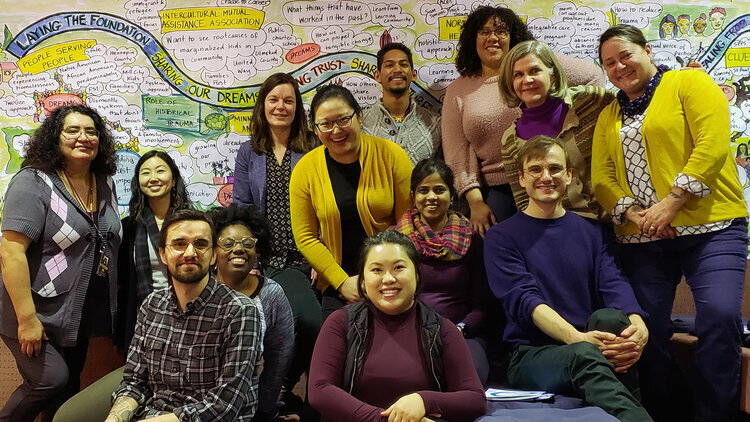
In late 2015, a small group from the Humphrey School and Dakota and Olmsted counties came together to consider these questions. Rooted in a vision of working across power, hierarchy, and perspectives to achieve a systems-level impact, the idea of an institute began to sprout. A university-led influencer and incubator, this place would convene and contain innovation and leadership development across sectors.
The original team dreamed broadly of ways the institute could take to achieve this goal, from peer learning networks to innovation labs, evaluation projects to leadership and capacity development. All were conceptualized within commitments to:
.jpg)
Attack institutional racism and other systemic inequality,
Work across organizations,
Alleviate the burden, stress, and fatigue in systems, and
Integrate services across systems, institutions, and agencies.
The dynamism of such an ambitious organization is reflected in some of the early projects of FSI, including the Equity Works Leadership Institute, Human Services Leadership Certificate, and developmental evaluation of the Gage East Housing Development in Rochester.
Not the research-from-afar model traditional to academia, the ever-changing work of direct collaboration with state and local governments has meant fast growth. Building on the Institute’s reputation for hosting learning spaces, and its expertise in developmental evaluation, human centered design, and 2-generational approaches, trust and relationships have continued to grow.
Since being established in the spring of 2016, programming has expanded and evolved, and so has the team. Come meet the members of the current Future Services Institute team.
-(1).jpg)